
Every November our export desk receives the same question from a new buyer: why would a glass wool factory in Tianjin send Thanksgiving greetings at all? The honest answer is that we do not send them to everyone. We send them to the partners who mark the date, and we keep the rest of the year for the work itself.
IN THIS NOTE
A NOTE, NOT A NOTICE · THANKSGIVING 2026
Who it is for: the customers, distributors and colleagues who celebrate Thanksgiving on Thursday, November 26, 2026.
What it changes: nothing. Not a price, not a lead time, not a specification, not a packing method.
What it costs you: two minutes of reading, and a reply if you feel like it.
Our order book runs through the United States, Canada, Europe, the Middle East, Southeast Asia and Latin America. In some of those places the fourth Thursday of November is a family day; in most of them it is a normal Thursday with trucks to load. We know the difference, and we would never hand a partner a greeting wrapped around a festival that is not on their calendar.
So this page is addressed to the people who will gather around a table this week: to the buyer who checked our thickness tolerance against his own scale, to the distributor who warned us about a port strike before we booked the vessel, to the colleague who answers messages at eleven at night. Thank you. The rest of the page simply explains what that word means in our daily work.
Walk through our plant in Tianjin and you will pass a wall where two words are painted larger than the safety signs: honest and careful. They are not decoration; they are the two failure modes we guard against — the temptation to promise a number we cannot hold, and the habit of treating an order as a transaction instead of a relationship.
Glass wool is bought on figures: density in kg/m³, thickness in millimetres, thermal conductivity at a stated mean temperature, fire reaction class, and the facing that decides how the material behaves on site. A supplier can win an order by quoting a density it cannot produce, and lose a customer six weeks later when the container is opened. We prefer to lose the order at the quotation stage. If a project needs an R-value our standard range cannot reach, we say so and propose the next grade up rather than a comfortable number.
The same rule applies after the goods exist. When a production batch drifts outside tolerance, the buyer hears it from us before the container is sealed — with the test report attached and the options spelled out: re-produce, downgrade with a price adjustment, or hold the shipment. Silence is cheaper in the short term and far more expensive later.
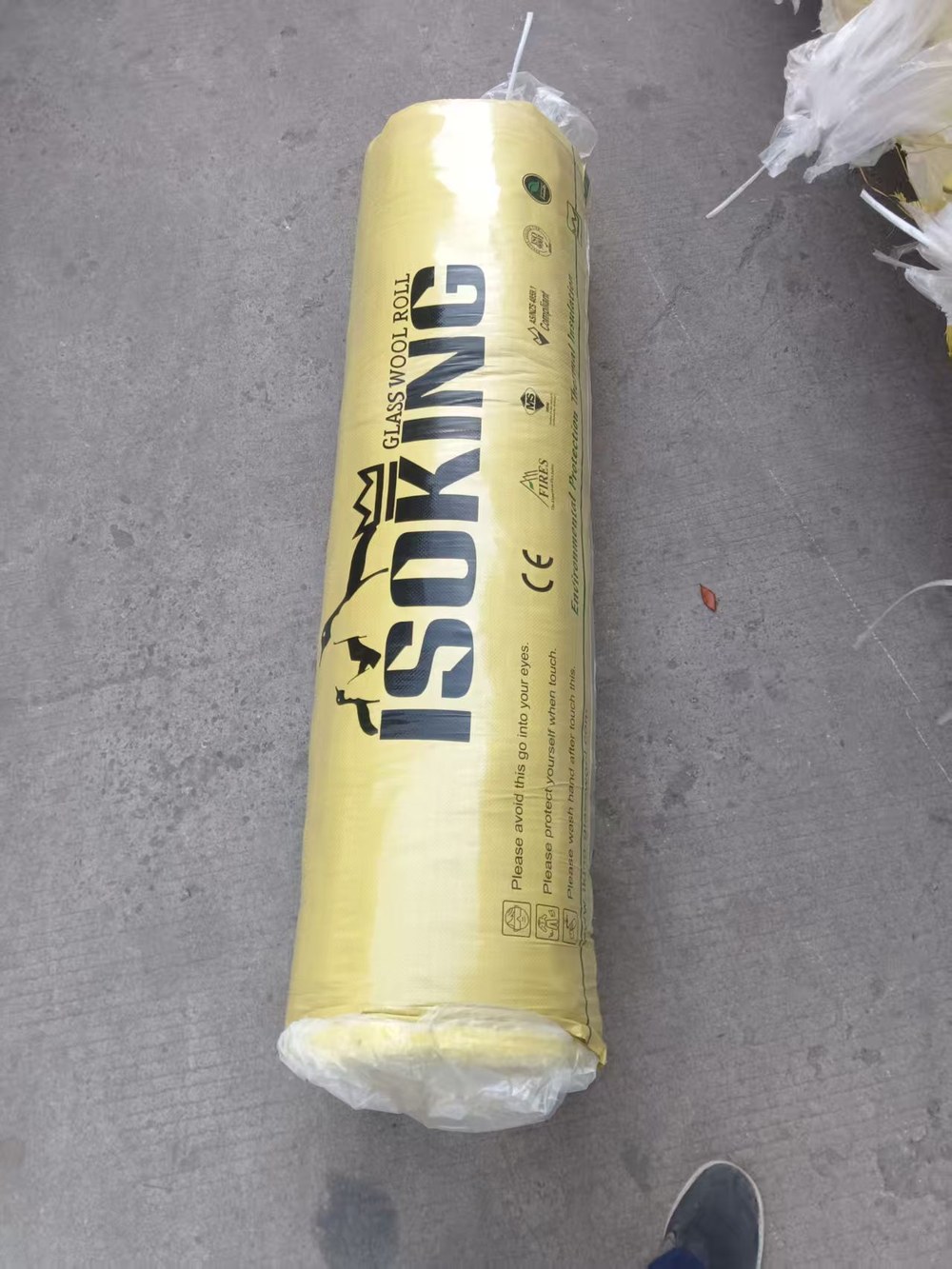
Each roll ships sealed in a marked ISOKING bag, so the grade printed on the label matches the grade inside the container.
Care rarely looks heroic. It looks like answering a technical question before the buyer’s working day ends on the other side of the world; like sending loading photos without being asked, because a customer three thousand kilometres away cannot walk into the container; like telling a first-time importer that the cheapest quote will cost him more in damaged edges and wasted container space.
None of that appears on an invoice. All of it is why some of our customers have been ordering from us for more than a decade.
Our other yearly appointment has nothing to do with insulation. In October, before the year-end rush begins, a group of colleagues from IKING spends a working day at a rehabilitation centre for children with autism in Tianjin. In 2026 they assembled sensory play equipment, sat down for an afternoon of clay crafts, and carried in the daily supplies the centre gets through in a few weeks.
We call these children the “children of the stars,” and we keep the reporting as quiet as the visit: no donation figures in the press, no photographs of faces, no seasonal campaign language. What we are willing to publish is the time — because the time is the part that repeats.
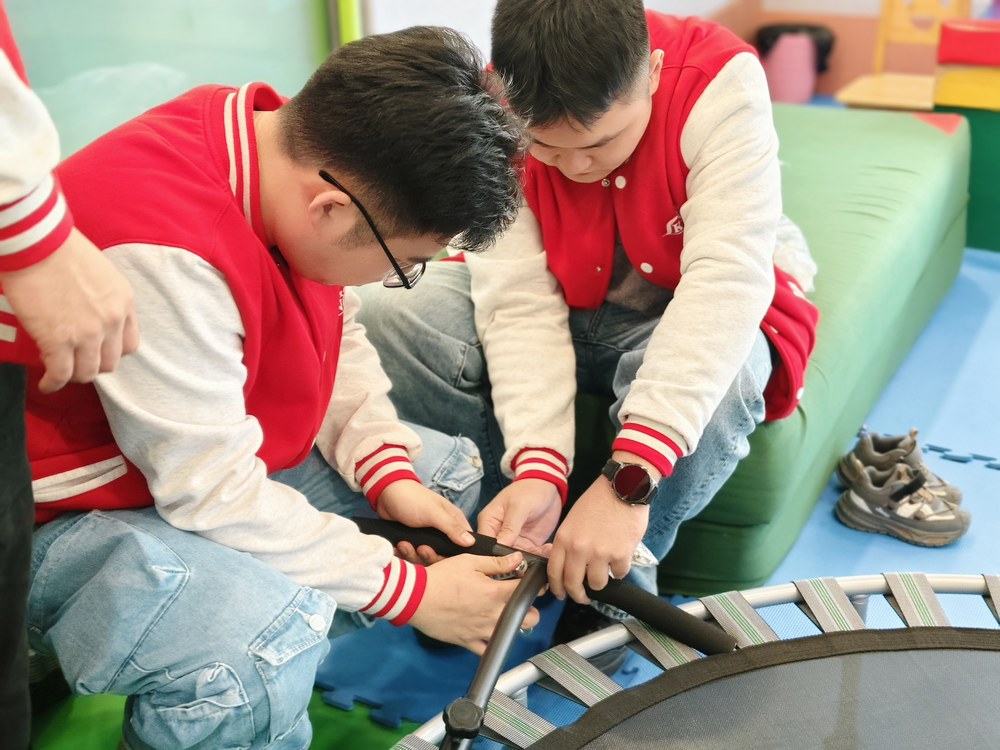
October 2026: volunteers from IKING assemble sensory play equipment for the children at a rehabilitation centre in Tianjin.

Clay crafts in the afternoon: no faces published, no donation figures reported, only the time we were there.
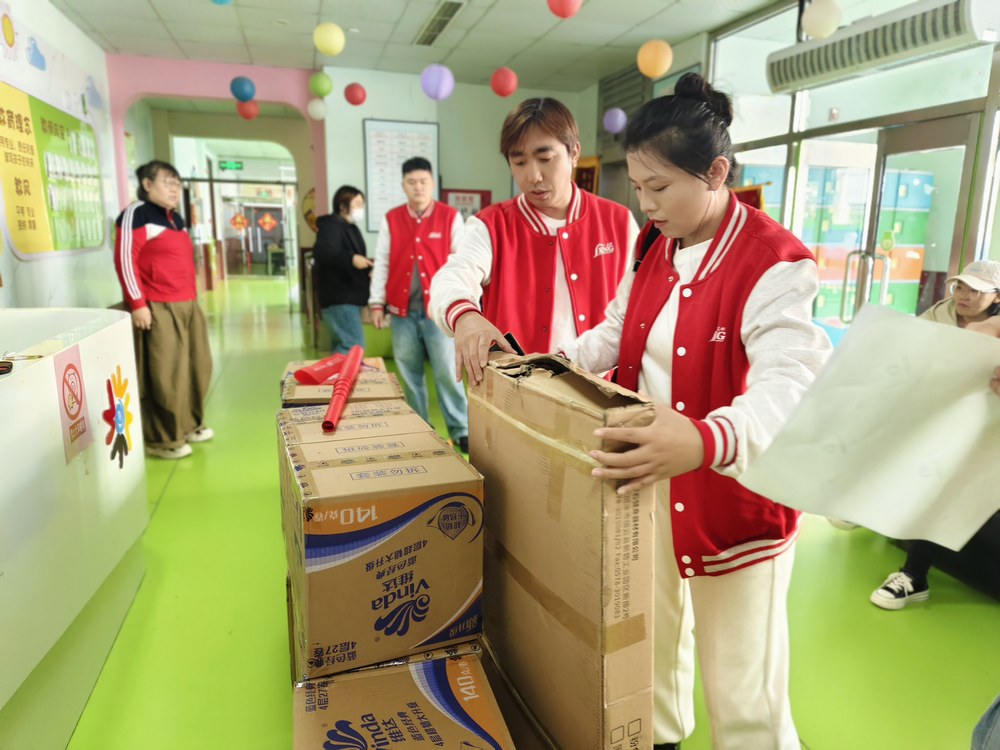
Daily supplies carried in by hand, chosen from the centre own list rather than ours.
Most of what we owe a customer is settled long before a greeting is written. Glass wool is a low-density material, so freight is decided by volume rather than weight: rolls are compressed to a ratio agreed with the buyer, sealed in moisture-proof bags, and stacked so that the pallet footprint matches the container floor. Boards travel with corner protection because a chipped edge is a rejected board on site. Pipe sections are nested so the wall thickness survives the journey.
When a project mixes products, we plan the loading sequence as well as the loading itself, so that the material the installer needs first is the material nearest the doors. Then we photograph the container, send the images, and let the customer see what we saw.
Specification pages for the three product families we ship most are here: glass wool blankets, glass wool boards and glass wool pipe sections. Anything else goes straight to the export desk.
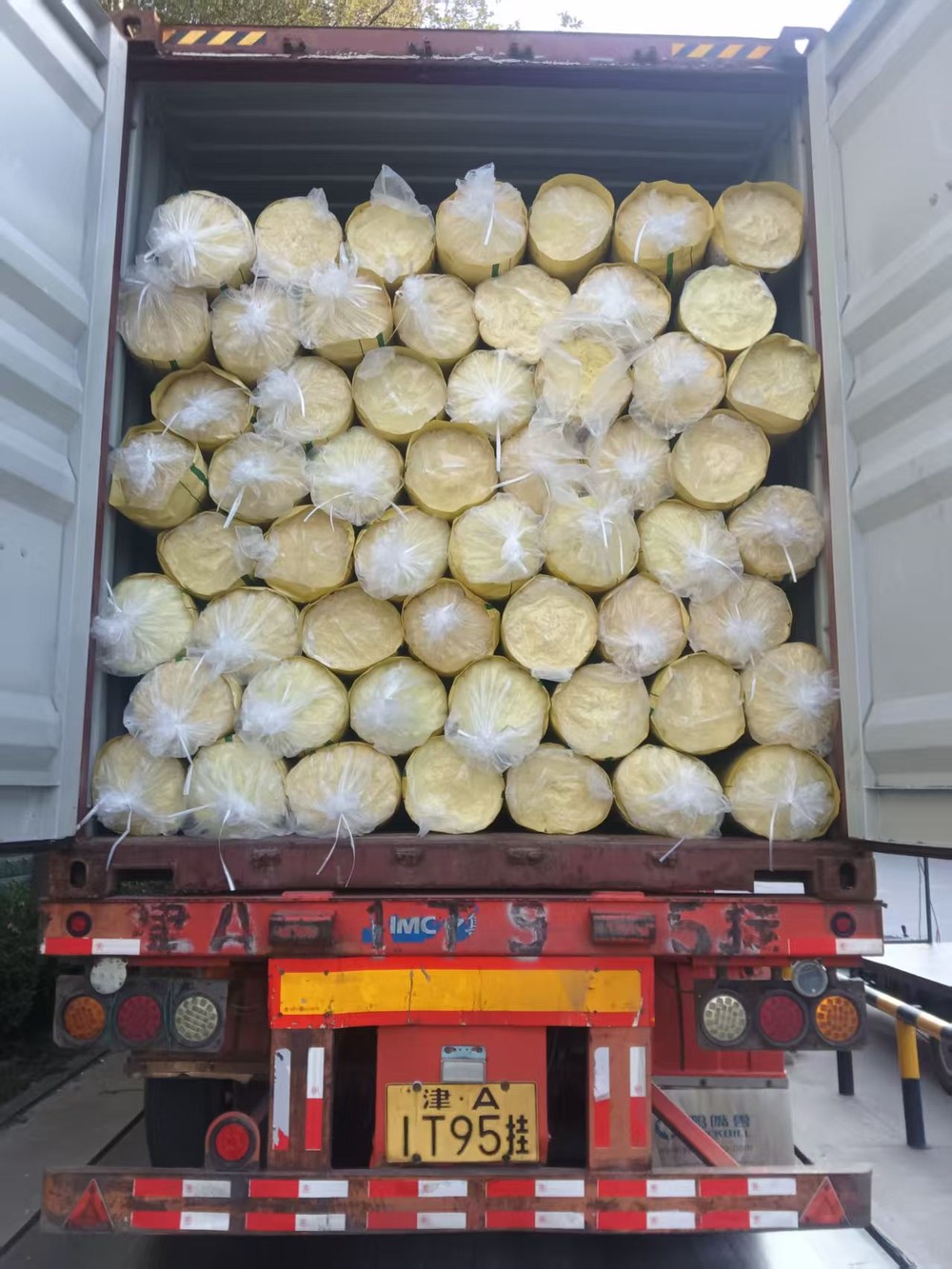
Compressed glass wool rolls loaded in a 40HQ container: compression ratio, edge protection and unloading sequence planned before the doors close.
A greeting is a strange place to talk about thermal conductivity, but half of the questions we answer in December are about performance rather than season’s wishes. Glass wool is spun from molten glass into fine fibres, bound with a thermosetting resin, and cured into a blanket, a board or a moulded pipe section. Its value in a building comes from three things at once: still air trapped between the fibres, a structure that does not burn, and a porous face that absorbs sound instead of reflecting it.
| Thermal conductivity | Typically 0.032–0.044 W/(m·K) measured at a mean temperature of 10 °C; the exact figure for each grade is stated on its test report, not in a brochure. |
| Density | Commonly 40–120 kg/m³. Higher density adds compressive strength and low-frequency sound absorption, not insulation value, so specifying 120 where 64 is enough only adds freight. |
| Fire behaviour | Non-combustible, classified A1 under EN 13501-1; it does not fuel a fire and releases no burning droplets. |
| Service temperature | Depends on binder and facing: standard building grades are rated around 250 °C, and the limit drops once a foil or kraft facing is applied. |
| Acoustics | Sound absorption rises with thickness and density; a 50 mm blanket against a rigid wall handles the mid and high frequencies that make plant rooms and partitions noisy. |
| Moisture | Water-repellent treatment keeps the fibres from soaking up condensate; a vapour barrier still belongs on the warm side of the assembly. |
| Formats and facings | Blankets with or without facing, rigid and semi-rigid boards, and pipe sections; facings in plain, aluminium foil, kraft or wire mesh. |
What that means in practice: the same roll can insulate a metal roof, quiet a machine room, or line an industrial oven — but never with the same specification. A specification written without knowing the substrate, the operating temperature and the acoustic target is a guess, and guessing is exactly what the word on the wall forbids.
Yes. The factory in China runs its normal schedule through the week of November 26, 2026. Overseas sales staff are on duty and answer within one working day; production and loading are unaffected.
No. Nothing in this article changes commercial terms. If a price, MOQ or lead time ever changes, it will arrive as a separate written notice with an effective date — never inside a greeting.
Not at all. Our calendar in China does not follow the American holiday, so orders from Europe, the Middle East, Asia and Latin America move exactly as usual. The note is simply addressed to the partners for whom the day matters.
Because we can, and because the visit is older than most of our export markets. It is a standing commitment rather than a marketing event, and it is the clearest way we have found to practise the second word on the wall.
Send the application, target density or R-value, thickness, facing, quantity and destination port through the inquiry form. A technical answer normally comes back within one working day, in your time zone.
If Thursday is a holiday where you are, enjoy it properly — the meal, the noise, the people.
If it is a normal working day, we are at our desk as usual. Send the project, the specification and the destination port, and the export team will come back with a technical answer.
Published by IKING Group — glass wool insulation manufacturer and engineering insulation supplier in China. Values: honesty and trustworthiness, gratitude and care.
CHINA IKING INDUSTRIAL GROUP CO., LTD
E-mail: info@iking-glasswool.com
Tel: 86-022-60767280
Fax: 86-022-58823477
Cel Phone: +8613312030322(Whatsapp/wechat)
Office Add: 14 floor, Zhiyun Building No.2, Hedong District, Tianjin City, China





